
India's Mars orbiter craft has completed eight years in its orbit, well beyond its designed mission life of six months. Plans on a follow-on 'Mangalyaan' mission to the Red Planet, however, are yet to be firmed up.

Former President and renowned scientist A P J Abdul Kalam on Tuesday complimented Indian Space Research Organisation for the successful launch of Mars orbiter.

The first Trajectory Correction Manoeuvre of India's maiden mission to Mars was on Wednesday carried out successfully by Indian Space Research Organisation scientists on the spacecraft, which is presently travelling some 2.9 million km away from Earth.

There was, however, no official word from the country's national space agency, headquartered in Bengaluru.

India successfully placed its spacecraft in orbit around Mars, becoming the first country in the world to succeed in such an inter-planetary mission in the maiden attempt itself.
Watch the live coverage of the 'Mars Orbit Insertion'.

The third of the total of five orbit raising manoeuvres of the Mars Orbiter spacecraft was performed early on Saturday, raising its apogee, the farthest point from Earth, to over 71,000 km.

Tanmaya Nanda provides a quick guide to questions about the Mars mission you always wanted to ask but were afraid to

Indian-American scientist Amit Kshatriya's journey from watching rocket launches in Houston to becoming NASA's Associate Administrator is a testament to his dedication and expertise in space exploration.

The mission ferries four astronauts -- NASA's Reid Wiseman, Christina Koch and Victor Glover and Canada's Jeremy Hansen -- onboard the Orion spacecraft for a 10 day lunar flyby. Unlike the Apollo missions that aimed for landing, Artemis II is focused on testing. The crew will evaluate critical systems such as life support, navigation, and communication in deep space -- essential steps before humans can return to the lunar surface.

Four astronauts from NASA's Artemis II mission have safely returned to Earth after completing a historic flyby of the moon, marking the first human journey to the moon in over 50 years.

Six planets -- Mercury, Venus, Mars, Jupiter, Saturn, and Uranus -- will appear together in the evening sky.

Glimpses from Artemis II's dramatic return to Earth

ISRO has announced plans for seven launch missions by March, including the first uncrewed mission for the Gaganyaan project and demonstrations of new satellite technologies.

Crossing a major milestone in the country's space history, ISRO's Mars Orbiter mission ventured out of Earth's sphere of influence for the first time in an attempt to reach the red planet's orbit

"Since its injection into Earth's orbit yesterday, it has been functioning smoothly on the orbit. We are planning to perform orbit raising manoeuvres in the early hours of of Thursday," an Indian Space Research Organisation spokesman told PTI over phone.

"We started it by 1.17 am and have successfully completed the first orbit raising manoeuvre of Mars Orbiter Spacecraft. Right now, the computation is going on," an ISRO spokesman told PTI.

NASA astronaut Sunita Williams retires after 27 years, completing three missions aboard the International Space Station and setting numerous spaceflight records. She is currently visiting India.
ISRO Chairman V Narayanan announced the development of a massive rocket capable of placing 75,000 kg payloads in low earth orbit, highlighting India's growing space capabilities and future satellite launches.
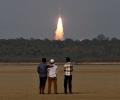
As NASA's Perseverance rover landed on Mars to look for signs of past life, ISRO chief K Sivan said India's next mission to the Red Planet is likely to be an orbiter.
Indian Space Research Organisation's Mars Orbiter, which was placed in inter-Mars trajectory in the early hours on Sunday, has crossed Moon's orbit and is travelling beyond Earth's natural satellite.

The Mars Colour Camera onboard Indian Space Research Organisation's Mars Orbiter Mission has captured the image of Phobos, the closest and biggest moon of Mars.
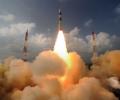
The second orbit raising manoeuvre of India's Mars Orbiter spacecraft was performed in the early hours of Friday, three days after its successful launch by PSLV C-25 into orbit around the Earth.

Indian Space Research Organisation has successfully realigned the orbit of its Mars Orbiter Mission 'Mangalyaan' so it is not affected by long-duration eclipse, ISRO Chairman A S Kiran Kumar said.

Nail-biting moments gave way to celebratory mood at the command centre of Indian Space Research Organisation in Bangalore on Wednesday, as its Mars Orbiter Mission or Mangalyaan entered the red planet's orbit.

In a major boost to the Indian scientific community, the Mars Orbiter Mission (Mangalyaan), on its maiden tryst with the red planet, has completed 300 days of its journey in space and is just 23 days away from reaching its intended orbit.

Kwatra termed India's successful launch of an American communication satellite on Wednesday as a 'very important and big day' for partnership between Washington and New Delhi, saying it caps a series of achievements in 2025 in bilateral space cooperation between the countries.

The Mars Orbiter Mission, or MOM, India's first planetary mission to explore Mars, has successfully completed one year around the Red planet on Thursday.

In a crucial manoeuvre ahead of India's Mars orbiter's entry into the final destination on September 24, the main liquid engine on the spacecraft was on Monday successfully test fired and its trajectory corrected.

Although the designed mission life of MOM was six months, the satellite has continued to beam back science data from Mars for the past four years.
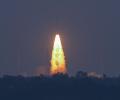
A PSLV rocket carrying Earth observation satellite EOS-09 failed to launch from the Sriharikota spaceport early on Sunday.
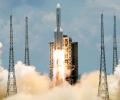
The Chinese Mars probe named Tianwen 1, or Quest for Heavenly Truth 1, will fulfil three scientific objectives: orbiting the red planet for comprehensive observation, landing on Martian soil and sending a rover to roam the landing site.

On Monday, ISRO scientists will run a test of the Mars orbiter satellite's main engine and make a small course correction. This is crucial because the engine has been idle for nearly 10 months. T E Narasimhan reports

India's Mars orbiter has sent a picture of regional dust storm activities over the northern hemisphere of the red planet, Indian Space Research Organisation said on Monday.

Amit Kshatriya, a decorated Indian-American and NASA veteran, has been appointed as NASA's new associate administrator, marking a significant step in the agency's exploration efforts.

India has completed a significant amount of work on next year's planned Mars mission for which scientific payloads have been short-listed, with formal government approval for the ambitious venture expected soon.

After having successfully completed three orbit raising manoeuvres, ISRO's Mars Orbiter mission on Monday suffered a glitch as it failed to achieve the targeted apogee (farthest distance from Earth) of one lakh km during the fourth orbit raising operation in the early hours.

In a once-in-a-million-years encounter, a comet, the size of a small mountain, flew past Mars on Sunday.
Following are some interesting facts about the 1,350-kg 'Mangalyaan' mission and its launch

India's successful launch of its Mars mission has been described by the mainstream American media as "technological leap" and "a symbolic coup" against China in this field.
 © 2026 Rediff.com - Advertise with us - Disclaimer - Privacy Policy - Sitemap - Feedback - About us - Terms of use - Grievances